

Elastic ligament connecting adjacent vertebral laminae. Thickening can contribute to narrowing of the spinal canal.
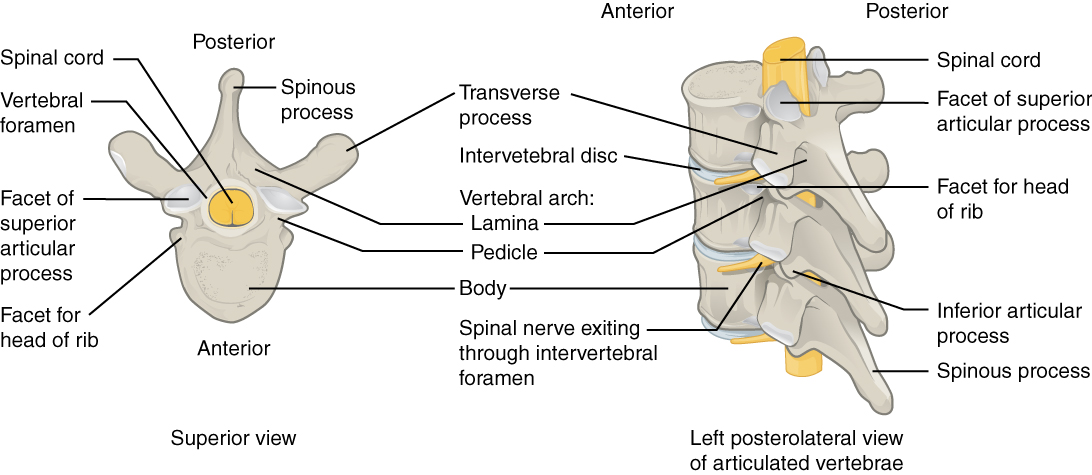
OpenStax College — CC BY 3.0. Image source.

Understanding the structure and its role
This ligament connects the laminae of neighboring vertebrae at the back of the canal. Elastic fibers account for its yellowish color and name. It accommodates changing distances between laminae during movement. With some degenerative changes, it may thicken or buckle toward the canal and contribute to narrowing.
Symptoms and assessment
Ligamentum flavum hypertrophy is an imaging finding rather than a symptom. Its relevance depends on associated stenosis and nerve function. Walking difficulty relieved by sitting can suggest lumbar stenosis, while hand and balance problems warrant assessment for a cervical cause.
Assessment considers symptom onset, distribution, restricted activities and medical history. Imaging findings must be compared with the clinical examination: a visible abnormality does not, on its own, establish the source of pain.
Management and outlook
Management addresses the whole clinical presentation. Exercise may improve endurance without thinning the ligament. When compression requires surgical decompression, the surgeon determines which tissues to release; that procedure differs from motorized traction.
For a mechanical problem without concerning findings, care aims for a gradual return to activity, individually selected exercises and measurable functional goals. Manual care may complement this approach when the examination supports it. Progress is judged through walking, sleep and daily tasks, as well as symptoms, rather than through an image alone.
When to seek prompt assessment
New or progressive weakness, newly impaired walking, loss of sensation around the saddle region, or new bladder or bowel control problems require urgent medical assessment.
Frequently asked questions
Does hypertrophy mean a tumor?
No. It usually describes thickening that must be interpreted in context.
Can laser remove a thickened ligament?
That outcome cannot be guaranteed or presented as an established effect.
Can imaging establish the diagnosis alone?
No. Findings must fit the clinical history and examination before they guide treatment.
Should all activity stop?
Usually not: loading is adjusted and gradually increased according to tolerance and the diagnosis.
How should progress be monitored?
Track functional abilities, neurological symptoms and resumed activities so care can be adjusted.
Concept diagram showing key relationships; this is not a scan or an anatomical drawing to scale.
Role of TAGMED care
At TAGMED, this information helps clarify your history, guide assessment and determine whether conservative care is appropriate or medical referral is needed. An anatomical structure, sign or test result is not, by itself, an indication for decompression, laser, shockwave or manual treatment. Care selection depends on the cause of symptoms and your clinical circumstances.
Medical references
- OpenStax, Rice University. Anatomy and Physiology 2e — The Vertebral Column.
- NIAMS, National Institutes of Health. Spinal Stenosis.
- NIAMS, National Institutes of Health. Spinal Stenosis: Diagnosis, Treatment, and Steps to Take.
References document the topic; their inclusion does not imply endorsement of TAGMED services by those organizations.
Educational information from The Spine Page. This entry does not replace an individual assessment. Documentary version: October 12, 2026. Sylvain Desforges, B.Sc., D.O., N.D., osteopath and naturopath.
TAGMED clinic contact details
For non-urgent consultations and information about available services.
Clinique TAGMED — Terrebonne
1150, rue Lévis, Suite 200
Terrebonne (Québec) J6W 5S6
450‑704‑4447
Clinique TAGMED — Montréal
1140, avenue Beaumont
Mont-Royal (Québec) H3P 3E5
1‑877‑672‑9060