

A dorsal root ganglion is a cluster of sensory neuron cell bodies associated with a spinal nerve. Usually located near an intervertebral foramen, it participates in carrying sensory information from the body toward the spinal cord.
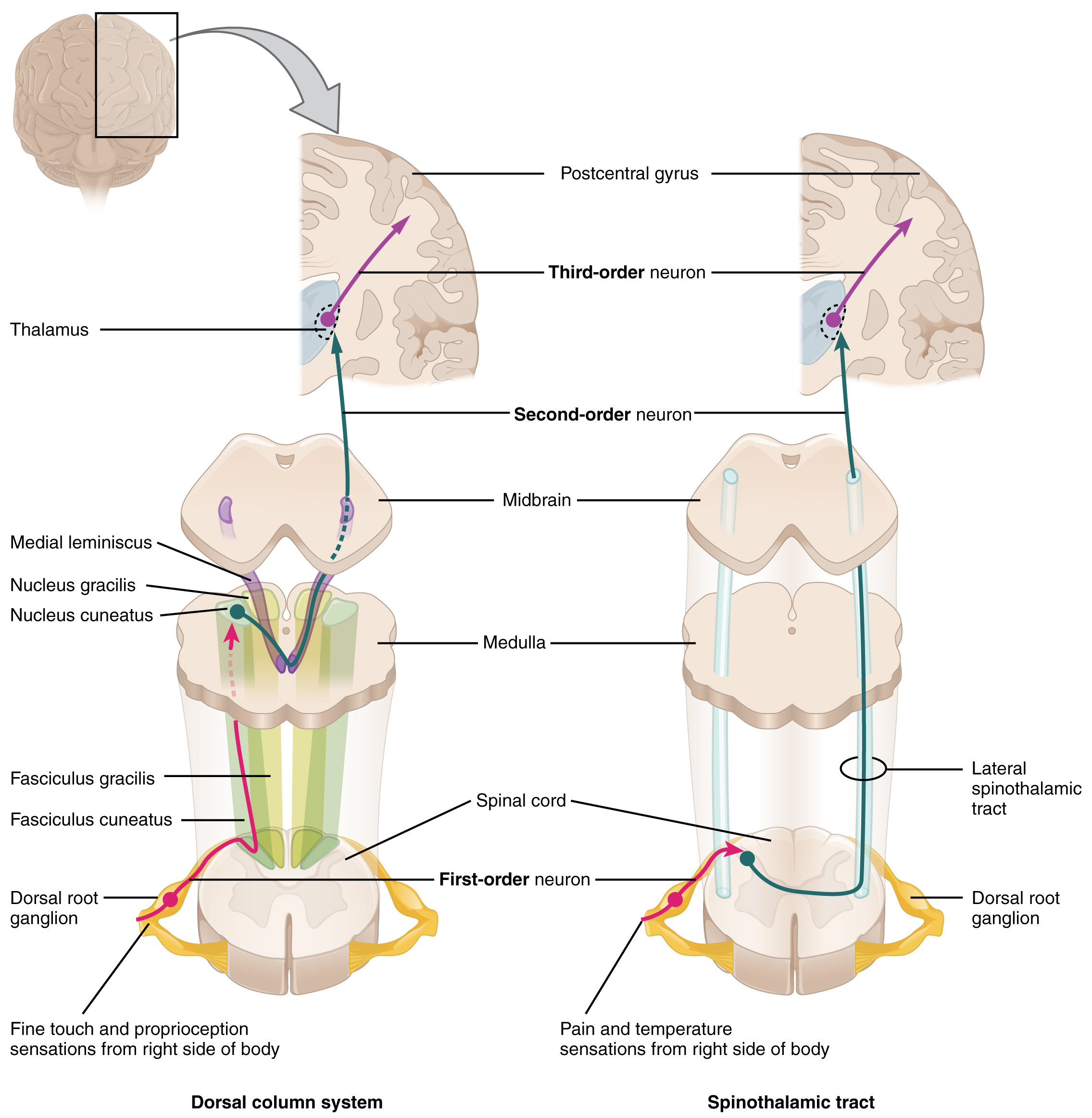
OpenStax College — CC BY 3.0. Image source.

Structure and function
The ganglion belongs to the peripheral nervous system. Its neurons have processes linking body tissues with central sensory pathways. They participate in information about touch, body position and pain. This neural ganglion is different from a lymph node involved in immune function, despite a similar word being used in some languages.
Possible manifestations
Irritation or injury near the ganglion can contribute to burning, electric sensations or numbness. Those descriptions do not precisely locate the affected tissue. Nerve roots, peripheral nerves and other structures can produce similar symptoms. A particular skin distribution is informative but does not automatically identify one ganglion as the source of the problem.
Assessment and management
Assessment examines sensation, strength, reflexes and symptom distribution. MRI or electrophysiological investigations may add information for selected questions; they are not routine for every sensory complaint. Management addresses the cause and functional consequences. Procedures targeting a ganglion belong to specialist teams and have their own indications, evidence and risks.
Role of TAGMED care
At TAGMED, sensory symptoms should be incorporated into an appropriate neurological assessment, with referral when indicated. Conservative care should not promise ganglion regeneration. Less pain does not independently demonstrate neuronal repair, and external stimulation should not be equated with an implanted device targeting a specific ganglion.
Warning signs
Progressive weakness, altered walking or new urinary dysfunction requires urgent medical assessment. Major sudden neurological changes need emergency evaluation and should not be attributed simply to muscle tension or postponed until a routine physical treatment appointment.
Frequently asked questions
Is it a lymph node?
No. It contains sensory nerve cell bodies.
Does it directly command muscle strength?
Its main role is sensory; motor pathways are distinct.
Does burning prove ganglion injury?
No. Several mechanisms can produce that sensation.
Can it be palpated in the back?
No. It lies deep near neural passageways.
Is external stimulation equivalent to a targeted implant?
No. Techniques, indications and supporting evidence differ.
Conceptual anatomical and clinical relationships; not drawn to scale.
Medical references
- National Library of Medicine. Ganglia, Spinal — MeSH D005727.
- UTHealth Houston — Neuroscience Online. Anatomy of the Spinal Cord.
- ACR — RSNA. Spine MRI.
References document the topic; their inclusion does not imply endorsement of TAGMED services by those organizations.
Educational information from The Spine Page. This entry does not replace an individual assessment. Documentary version: October 12, 2026. Sylvain Desforges, B.Sc., D.O., N.D., osteopath and naturopath.
TAGMED clinic contact details
For non-urgent consultations and information about available services.
Clinique TAGMED — Terrebonne
1150, rue Lévis, Suite 200
Terrebonne (Québec) J6W 5S6
450‑704‑4447
Clinique TAGMED — Montréal
1140, avenue Beaumont
Mont-Royal (Québec) H3P 3E5
1‑877‑672‑9060