

Reduced space between adjacent vertebral bodies, usually reflecting loss of disc height; this finding does not itself prove nerve compression.
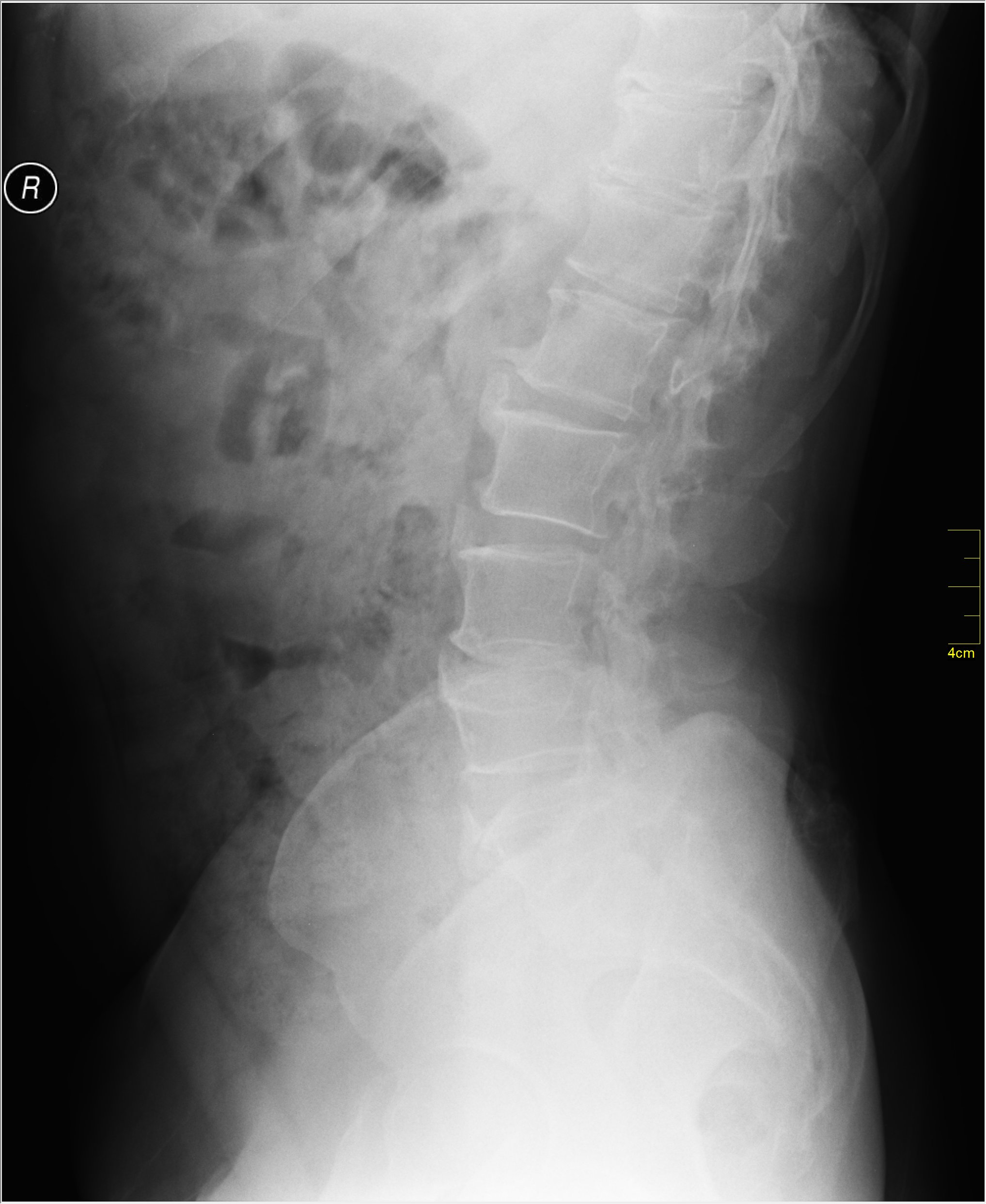
© Nevit Dilmen — CC BY-SA 3.0. Image source.

Understanding this term
Disc-space narrowing describes reduced space between two vertebral bodies, often assessed on radiographs. It mainly indicates disc height. Narrowing does not mean a nerve is necessarily pinched. Height loss can, however, reduce foraminal dimensions and change how loads are distributed.
Symptoms and assessment
This finding may accompany degeneration, but context matters. Local pain, radiating symptoms or no symptoms are all possible. Unusual or rapidly changing narrowing with fever requires medical investigation. MRI may clarify disc and nerve findings when it is likely to change decisions.
Assessment considers symptom onset, distribution, restricted activities and medical history. Imaging findings must be compared with the clinical examination: a visible abnormality does not, on its own, establish the source of pain.
Management and outlook
Management targets daily function and any neural consequences. Symptom relief does not prove permanent restoration of height. Images taken in different positions cannot by themselves establish that treatment widened a disc space.
For a mechanical problem without concerning findings, care aims for a gradual return to activity, individually selected exercises and measurable functional goals. Manual care may complement this approach when the examination supports it. Progress is judged through walking, sleep and daily tasks, as well as symptoms, rather than through an image alone.
Motorized spinal decompression is a form of traction. It cannot guarantee disc repair or disappearance of a herniation. NICE does not recommend traction for low back pain with or without sciatica; any proposed care should therefore explain uncertainty, alternatives and the criteria for reassessment.
When to seek prompt assessment
New or progressive weakness, newly impaired walking, loss of sensation around the saddle region, or new bladder or bowel control problems require urgent medical assessment.
Frequently asked questions
Does disc-space narrowing mean nerve compression?
No. Disc height and nerve-root status are separate questions.
Are the vertebrae always touching?
No. The degree of narrowing varies and should be described accurately.
Can imaging establish the diagnosis alone?
No. Findings must fit the clinical history and examination before they guide treatment.
Should all activity stop?
Usually not: loading is adjusted and gradually increased according to tolerance and the diagnosis.
How should progress be monitored?
Track functional abilities, neurological symptoms and resumed activities so care can be adjusted.
Concept diagram showing key relationships; this is not a scan or an anatomical drawing to scale.
Role of TAGMED care
TAGMED offers motorized spinal decompression, a form of traction. Initial assessment considers whether symptoms, neurological findings and imaging, when indicated, agree. The value of this approach remains uncertain depending on the condition; NICE recommends against offering traction for low back pain with or without sciatica. It does not guarantee disc resorption, disc repair or correction of stenosis. Alternatives, contraindications, functional goals and stopping criteria should be discussed before any trial.
Medical references
- NASS / ASSR / ASNR; The Spine Journal. Lumbar disc nomenclature: version 2.0 (Fardon et al., 2014).
- American Academy of Orthopaedic Surgeons. Cervical Radiculopathy (Pinched Nerve).
- National Institute for Health and Care Excellence. NG59 — Low back pain and sciatica in over 16s: recommendations.
References document the topic; their inclusion does not imply endorsement of TAGMED services by those organizations.
Educational information from The Spine Page. This entry does not replace an individual assessment. Documentary version: October 12, 2026. Sylvain Desforges, B.Sc., D.O., N.D., osteopath and naturopath.
TAGMED clinic contact details
For non-urgent consultations and information about available services.
Clinique TAGMED — Terrebonne
1150, rue Lévis, Suite 200
Terrebonne (Québec) J6W 5S6
450‑704‑4447
Clinique TAGMED — Montréal
1140, avenue Beaumont
Mont-Royal (Québec) H3P 3E5
1‑877‑672‑9060