



In Westmount, sciatica can make everyday activities more difficult: sitting at a desk, driving, climbing stairs, or simply finding a comfortable sleeping position. Thoughtful lifestyle adjustments may improve comfort, but pain that travels down the leg does not always have the same cause and is not managed the same way for everyone.
What is often most helpful is finding a balance between tolerable movement and rest, temporarily adapting posture and the environment, and seeking an assessment if symptoms persist, worsen, or are accompanied by weakness. The following advice provides cautious guidance for daily pain, without replacing a personalized examination.


In brief: guidance for living with sciatica in Westmount
- Pain that travels down the buttock and leg may suggest nerve irritation, but the pain pattern alone does not reveal either the cause or the nerve root involved.
- Avoiding prolonged immobility is generally preferable to strict bed rest. Short periods of walking and changes in position may help if symptoms allow.
- Ergonomics is about adaptation, not a perfect posture to maintain all day. Alternating positions and taking breaks often matter more than a particular chair.
- Persistent pain, numbness, or weakness warrants an assessment. Bladder or bowel problems and saddle numbness require urgent medical care.
Understanding sciatica and daily pain
The term sciatica generally describes pain related to irritation of a nerve root in the lower back, radiating into the buttock and sometimes farther down the leg. It may be sharp, burning, electric, or accompanied by tingling and numbness. Low back pain refers to pain localized in the lower back; the two can coexist, but one does not automatically prove the other.
A disc herniation or bulge may contribute to irritation of a nerve root. Other situations, such as narrowing of the spinal canal or a foramen, may also be involved. Pain felt in the buttock can also have a muscular or joint-related origin; this is why recognizing a pain pattern is not enough to make a diagnosis.
The L4, L5, and S1 nerve roots are often involved in lower back symptoms radiating into the leg. Certain areas of the foot or leg may help the clinician guide their examination, but pain patterns overlap and vary from one person to another. The history of symptoms and examination of strength, sensation, and movement must be interpreted together; imaging is not necessary in every case.
In Westmount, a day of desk work, a car commute, or a long period without moving can make symptoms harder to manage. This does not necessarily mean that a posture has “moved” a disc or caused an injury. A position may simply be less tolerable at that time. To learn more about the causes and assessment steps, see the guidance on possible causes of sciatica.
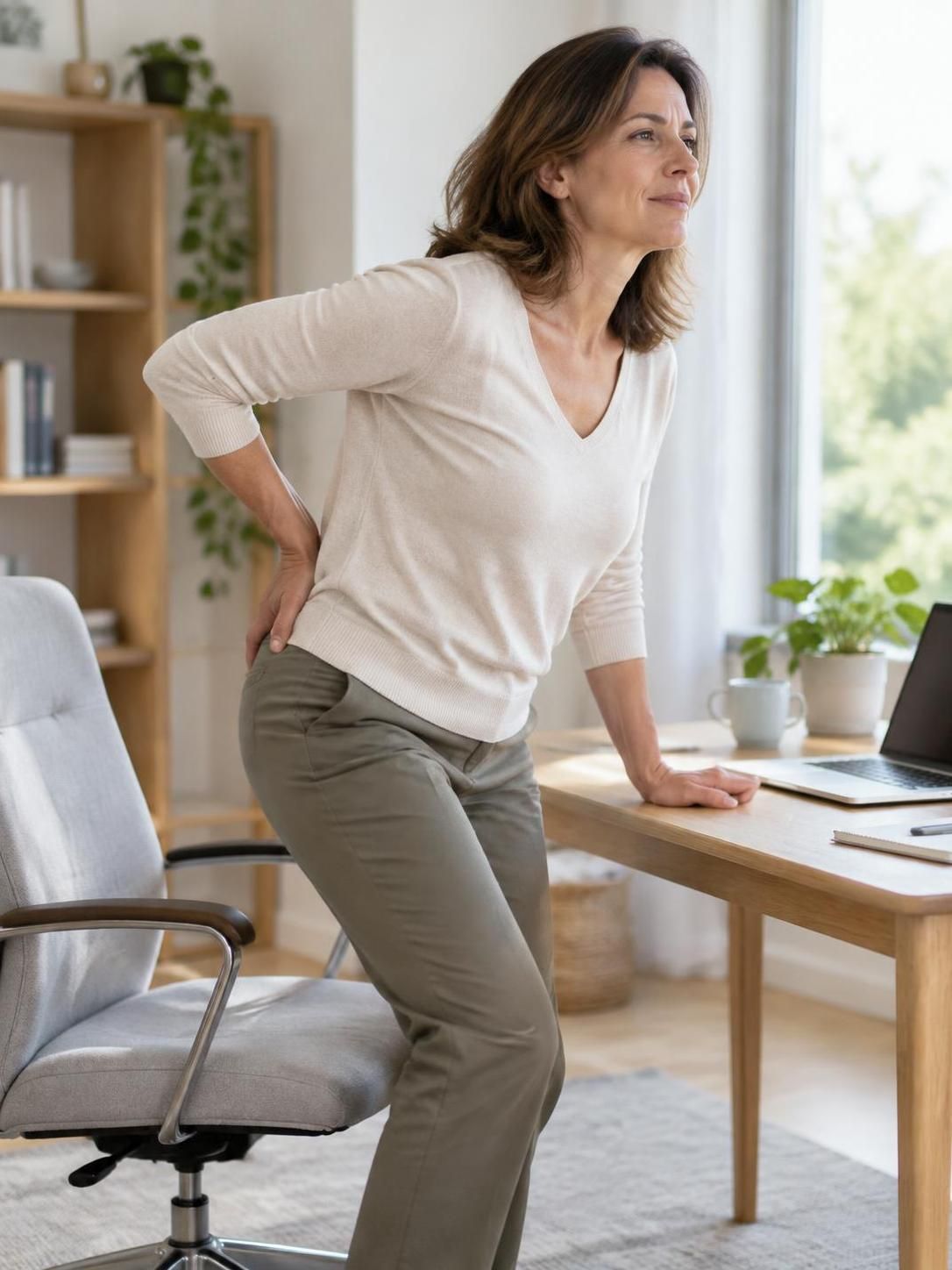
Lifestyle habits, posture, and ergonomics at the office or in the car
There is no single ideal posture that suits everyone with sciatica. A chair adjusted so that your feet rest comfortably on the floor, a screen placed at a practical height, and lumbar support that does not force your back can make work more tolerable. The goal is not to remain perfectly upright, but to be able to change position without excessive difficulty.
If sitting increases symptoms, try standing up and walking for a few moments before the discomfort becomes too pronounced. Some people benefit from frequent breaks, while others need to adjust their chair or schedule. Alternating between sitting and standing work can be tried gradually, without any obligation to remain standing if it increases pain.
Driving requires a relatively fixed position. Before a trip, adjust the seat so you can reach the pedals without stretching your legs, and position the seatback to support your torso without feeling restricted. When a trip is long, plan safe stops to stretch your legs. In Westmount, as elsewhere in the Montréal area, daily travel may also combine driving and walking: breaking up sitting time may then be more realistic than seeking a perfect posture.
Bending forward, making a sudden twist, or lifting a load may be uncomfortable during a flare-up, but these movements are not universally prohibited. To move an object, keep it close to your body, take time to turn using your feet, and avoid rushed movements. Practical sitting advice is provided in this guide to make sitting more tolerable; adapt it to your response rather than following a rigid rule.
| Common situation | Cautious adjustment | What to watch for |
|---|---|---|
| Office work | Alternate positions and take short movement breaks. | Pain that travels farther down the leg or worsens persistently. |
| Driving | Adjust the seat and interrupt long trips when possible. | Weakness or loss of sensation that interferes with foot control. |
| Sleep | Choose a comfortable position and change sides if needed. | Persistent nighttime symptoms that disrupt rest. |
Gentle exercises and gradual return to movement
When pain limits mobility, rest may seem like the most reassuring solution. However, staying in bed for a long time can promote stiffness and reduce tolerance for activities. If no warning signs are present and movement remains tolerable, short walks or light tasks spread throughout the day may help maintain mobility.
Gentle exercises are not a universal formula. A stretch for the buttocks or the back of the thigh may suit some people and irritate symptoms in others. Nerve mobilization should remain slow and controlled; it should not cause pain that clearly increases, travels farther down the leg, or is accompanied by increasing numbness.
A useful rule is to observe your response during and after activity. If a short walk is well tolerated, its duration can be increased gradually rather than immediately moving on to a long outing. If a movement causes weakness, persistently worsens pain, or reduces sensation, stop it and seek advice from a professional. There is no need to “push through” nerve pain.
Physiotherapy can help establish a tailored program, work on mobility, and gradually return to activities. Some directional exercise approaches, including the McKenzie method, are used after assessment; they are not automatically suitable for every profile. Core strengthening exercises may also be introduced at the appropriate time, without any few isolated movements being able to guarantee prevention of a recurrence.
A lumbar belt may sometimes provide occasional support for a specific activity, but it does not replace a gradual return to movement or an assessment when symptoms are concerning. For additional guidance, the exercises suggested for sciatica should be considered general information to be adjusted to your situation.
When to seek care and which management options to consider
A clinical assessment is indicated if pain persists or returns, travels below the knee, limits walking, or disrupts sleep. Numbness, loss of sensation, weakness, or reduced function also warrant professional advice, especially if the symptom is new or changing.
Seek urgent medical care if you lose control of your bladder or bowels, have numbness in the saddle area, or have significant or rapidly progressive weakness. Fever or a general deterioration in health, significant trauma, a history of cancer or infection, or rapid worsening also require medical assessment without delay.
Management depends on the examination, progression, and the person’s needs. It may include maintaining tolerated activities, tailored advice and exercises, as well as physiotherapy care or manual approaches when appropriate. Medications should be discussed with an authorized health professional, particularly when other health conditions or ongoing treatments are present.
For some persistent presentations, a physician may consider an injection or referral to a specialist. Surgery is assessed in selected situations, for example when compression and neurological signs warrant it; it is neither routine nor to be ruled out from the outset. The choice depends on the clinical presentation, expected benefits, and risks specific to each option.
Neurovertebral decompression is motorized, gradual, and controlled traction. After an assessment, it may be considered for certain patients whose symptoms are consistent with disc or foraminal involvement. It aims to temporarily modify certain mechanical stresses; it does not put a disc back in place, is not suitable for everyone, and never replaces an urgent assessment. Results vary, and no number of sessions can be universally recommended.
The suitability of this approach should be discussed with a professional who considers contraindications and the full clinical record. Clinique TAGMED, located at 1140 Beaumont Avenue in Mount Royal, near Outremont and Côte-des-Neiges, provides its information on neurovertebral decompression. A local description of the options is also available in this overview of sciatica in Westmount; it does not replace an independent clinical assessment.
Frequently asked questions about sciatica and lifestyle habits
{“@context”:”https://schema.org”,”@type”:”FAQPage”,”mainEntity”:[{“@type”:”Question”,”name”:”Faut-il u00e9viter complu00e8tement de su2019asseoir avec une sciatique ?”,”acceptedAnswer”:{“@type”:”Answer”,”text”:”Non. La position assise peut u00eatre moins bien tolu00e9ru00e9e, mais lu2019u00e9viter entiu00e8rement nu2019est pas nu00e9cessaire pour tout le monde. Essayez de varier les positions, du2019ajuster le siu00e8ge et de prendre des pauses selon votre confort.”}},{“@type”:”Question”,”name”:”La marche peut-elle aider une douleur qui descend dans la jambe ?”,”acceptedAnswer”:{“@type”:”Answer”,”text”:”Une marche courte et facile peut aider certaines personnes u00e0 conserver leur mobilitu00e9, si elle ne fait pas augmenter durablement les symptu00f4mes. Ru00e9duisez ou cessez lu2019activitu00e9 si la douleur progresse, si un engourdissement su2019accentue ou si une faiblesse apparau00eet.”}},{“@type”:”Question”,”name”:”Quand faut-il consulter pour une douleur compatible avec une sciatique ?”,”acceptedAnswer”:{“@type”:”Answer”,”text”:”Consultez si la douleur persiste, revient, limite vos activitu00e9s ou su2019accompagne du2019engourdissement ou de faiblesse. Une perte de contru00f4le urinaire ou intestinal, une anesthu00e9sie de la selle ou une faiblesse rapidement progressive exige une u00e9valuation mu00e9dicale urgente.”}},{“@type”:”Question”,”name”:”La du00e9compression neurovertu00e9brale convient-elle u00e0 toutes les sciatiques ?”,”acceptedAnswer”:{“@type”:”Answer”,”text”:”Non. Elle peut u00eatre envisagu00e9e chez certains patients apru00e8s u00e9valuation, mais les indications et les contre-indications varient. Les ru00e9sultats ne sont pas garantis et cette approche ne remplace ni les soins urgents ni les autres options recommandu00e9es selon le cas.”}}]}Should you completely avoid sitting with sciatica?
No. Sitting may be less well tolerated, but completely avoiding it is not necessary for everyone. Try varying positions, adjusting your seat, and taking breaks according to your comfort.
Can walking help pain that travels down the leg?
A short, easy walk may help some people maintain mobility if it does not persistently increase symptoms. Reduce or stop the activity if pain progresses, numbness worsens, or weakness develops.
When should you seek care for pain consistent with sciatica?
Seek care if pain persists, returns, limits your activities, or is accompanied by numbness or weakness. Loss of bladder or bowel control, saddle numbness, or rapidly progressive weakness requires urgent medical assessment.
Is neurovertebral decompression suitable for all cases of sciatica?
No. It may be considered for certain patients after assessment, but indications and contraindications vary. Results are not guaranteed, and this approach does not replace either urgent care or other options recommended based on the situation.
If pain travelling down your leg complicates your work, travel, or sleep, an assessment may help clarify the likely cause, signs to watch for, and the suitability of a conservative approach. For information on options available in Montréal, see the page on sciatica management.
Dr. Sylvain Desforges, B.Sc., D.O., N.D., osteopath
This content is educational and does not replace a personalized assessment or medical advice.
