


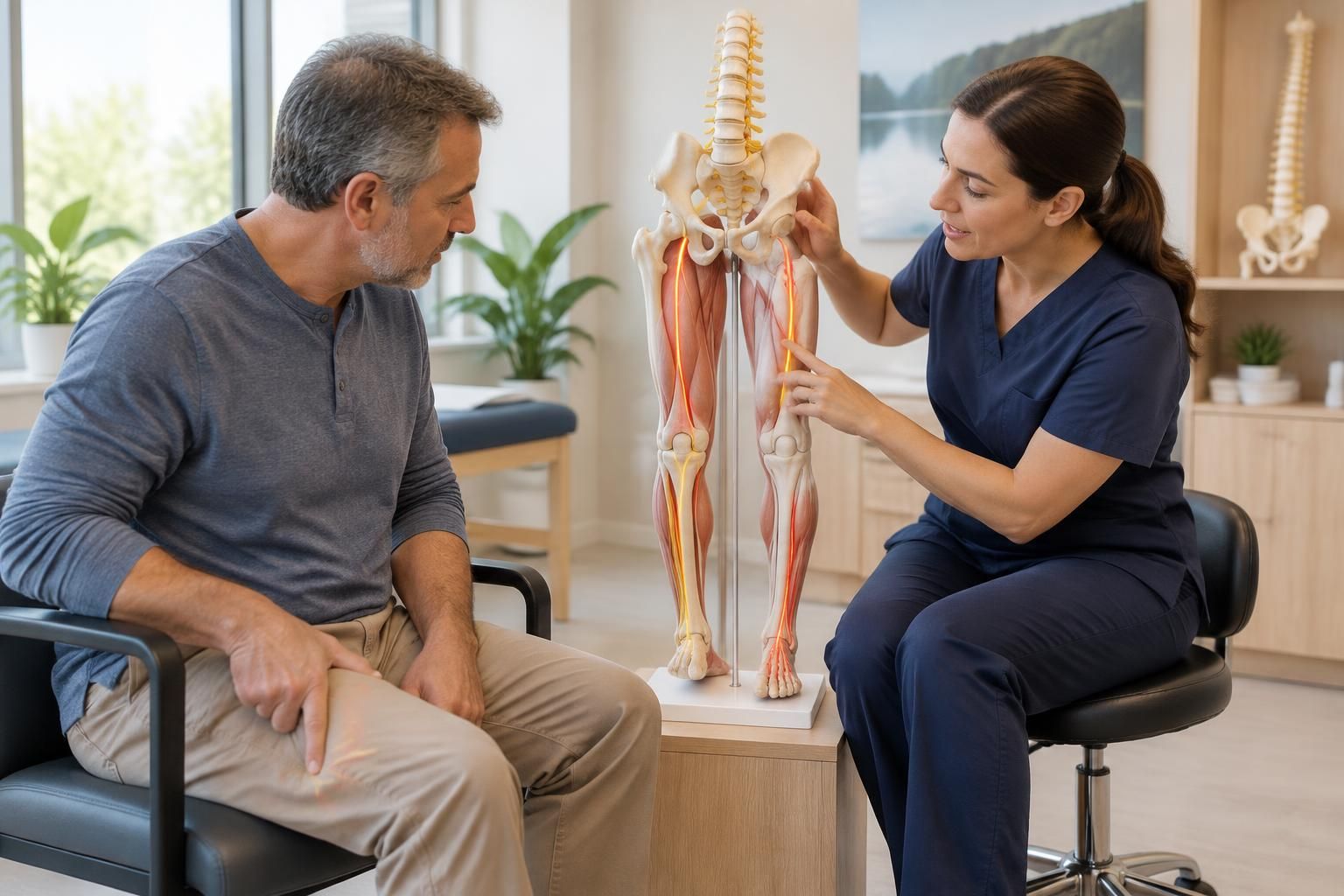
In Lachine, pain that travels down the leg may suggest sciatica or cruralgia, but its path alone is not enough to establish a diagnosis. In general, sciatica radiates to the buttock and back of the leg, whereas cruralgia more commonly affects the groin and the front or inner thigh.
This pain can limit walking, disrupt sleep, or make seated trips by car and public transit uncomfortable. A clinical examination helps distinguish radicular pain from other causes, such as a hip problem or muscle pain, and determine whether further tests are useful.


In brief: recognizing the differences without self-diagnosing
Typical path: sciatica often follows the back of the thigh and leg; cruralgia is more often felt at the front of the thigh, sometimes as far as the knee.
Possible origin: these types of pain may involve different nerve roots, but the pain path alone cannot precisely locate the affected area.
When to act: persistent pain, weakness, or loss of sensation warrants an assessment; certain signs, including urinary or bowel problems, require urgent care.
The word “sciatica” is often used to describe pain that travels down the leg. Cruralgia is less familiar, but the distinction matters mainly because the examination and possible causes are not exactly the same.
Sciatica or cruralgia: what the path of the pain may indicate
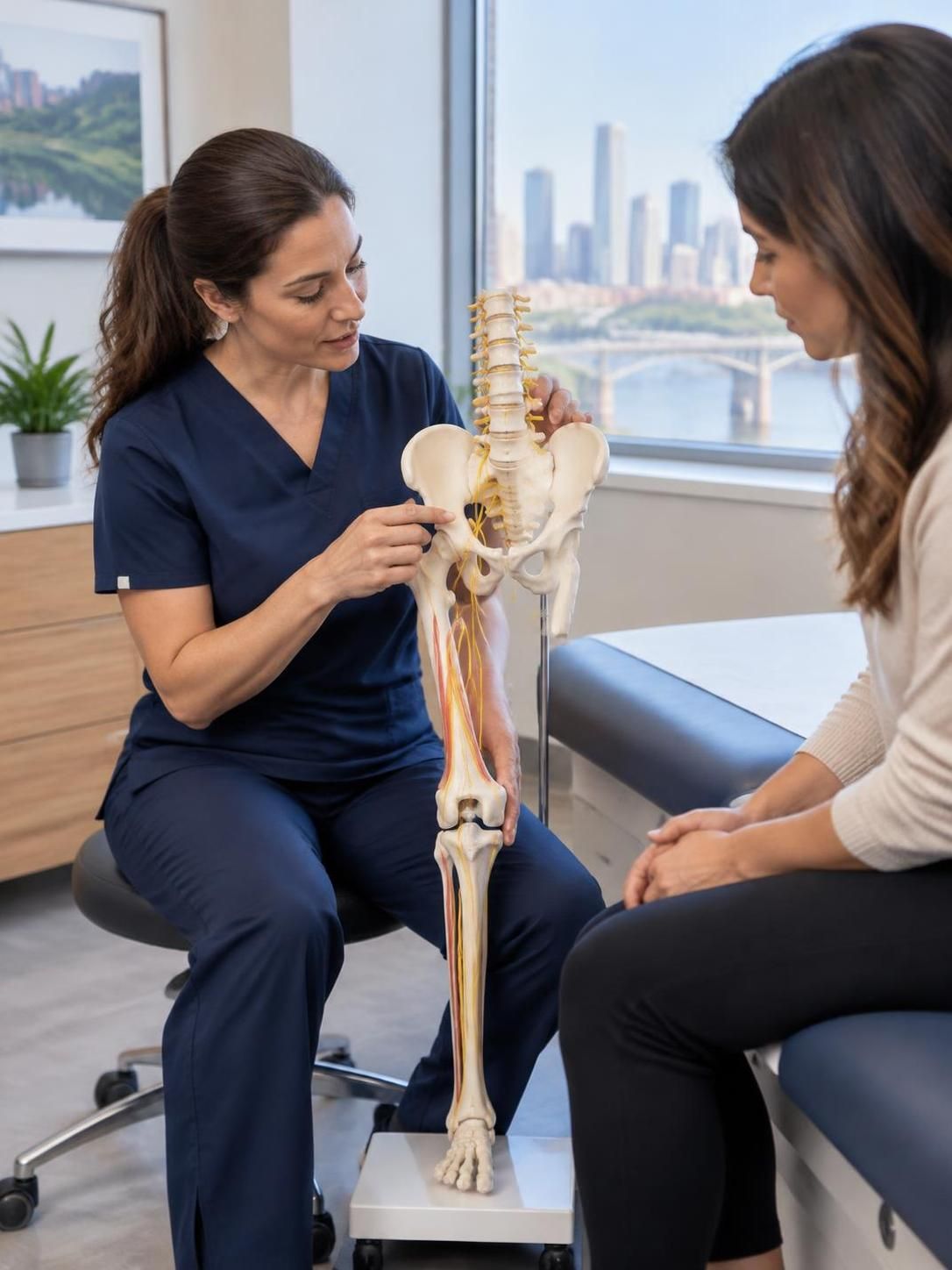
The sciatic nerve is formed by lumbar and sacral nerve roots, including L4 to S3. When one of these roots is irritated, pain may begin in the lower back or buttock, then travel down the back of the thigh toward the calf or foot. Tingling, numbness, or weakness may also be present, but their absence does not rule out pain of nerve origin.
The crural nerve, also called the femoral nerve, receives fibres mainly from the L2 to L4 roots. Cruralgia may be felt in the groin or at the front and inner thigh, sometimes as far as the knee. Difficulty straightening the knee or climbing stairs may accompany the symptoms, without being sufficient proof of their origin.
| Indicator | Sciatica | Cruralgia |
|---|---|---|
| Commonly described path | Buttock, back of the thigh, calf, or foot | Groin, front or inner thigh, sometimes the knee |
| Nerve roots that may be involved | Often L5 or S1, sometimes L4 | Often L2, L3, or L4 |
| Possible functional difficulty | Walking, weight-bearing, or foot movements | Knee extension, stairs, or rising from a chair |
| Limitation of this indicator | The path varies and does not, on its own, confirm the nerve or cause involved. | |
Low back pain may accompany either condition, but it can also occur without nerve irritation. Hip pain, a muscle injury, or another cause of leg pain can make the picture less clear. To explore the differences described in everyday language, see this resource on the distinction between sciatica and cruralgia.
An explanation focused on clinical reasoning is also provided in this guide to the differential diagnosis of sciatic pain. These resources can provide information, but do not replace an examination tailored to your symptoms.
Radicular pain: possible causes and factors that affect it
A disc herniation or protrusion can irritate a nerve root. Age-related joint changes, narrowing of the nerve exit space, or certain spinal conditions may also contribute to symptoms. However, an MRI image showing an abnormality does not prove that it explains the pain: it must be interpreted alongside the history and clinical examination.
Prolonged sitting, driving, bending, or certain exertion may increase discomfort for some people, whereas others experience more symptoms while walking or standing. In Lachine, for example, a person who alternates between remote work and car travel may notice that the pain varies according to time spent sitting; this observation is useful to report, but does not by itself identify the cause.
A professional can assess strength, sensation, reflexes, and mobility, then compare responses to certain movements. Imaging is not automatically needed at the outset: it may be considered based on duration, progression, examination findings, or the need to plan an intervention. The choice depends on the medical consultation and clinical context.
Diffuse pain does not always make it possible to distinguish between the two presentations. The most useful information is where it starts, how far it travels, what affects it, and whether weakness or loss of sensation occurs.
When to seek care in Lachine and which signs require urgent attention
A clinical assessment is appropriate if pain persists, returns regularly, travels below the knee, limits walking, or disrupts sleep. It is also prudent to seek care in the event of numbness, loss of sensation, weakness, or new difficulty performing usual tasks, such as climbing stairs or getting up from a chair.
Seek urgent medical care if you lose control of your bladder or bowels, have numbness in the saddle area, or have significant or rapidly progressing weakness. Fever or feeling unwell, significant trauma, a history of cancer, or an infection risk associated with new pain also warrant prompt assessment.
Rapid worsening requires immediate attention. These signs cannot establish a diagnosis remotely, but they should not be monitored only at home.
To better understand when to seek care, you can read the guidance on when to seek care for sciatica. While waiting for advice, avoid forcing a movement that clearly worsens the pain or makes symptoms travel farther down the leg.
Management options and the role of spinal decompression
When the situation allows, maintaining gentle activity and gradually resuming daily tasks may be preferable to prolonged strict rest. Exercises and movement advice should be adapted to the person’s response: stop an exercise if pain spreads further, numbness worsens, or weakness appears. Medications can be discussed with an authorized health professional, taking contraindications and other treatments into account.
Depending on the profile, management may include supervised exercises, appropriate manual care, or medical advice on other options, such as an injection. Surgery is not the usual answer to every type of pain radiating down the leg; however, specialist input may be indicated when there is a significant neurological deficit, concerning compression, or progression that warrants it.
Motorized spinal decompression is a form of controlled traction that may be considered for certain patients after assessment. It aims to temporarily alter the mechanical stresses placed on the spine; it does not put a disc back in place and is not appropriate for every cause of pain. Results vary, no number of sessions is suitable for everyone, and this approach never replaces an urgent assessment or medical referral when needed.
In Mont-Royal, near Outremont and Côte-des-Neiges, Clinique TAGMED indicates that it offers, depending on the assessment, motorized spinal decompression, specific osteopathy, or a precision percussion device. People from Lachine considering this approach can consult the page on how spinal decompression works and discuss its suitability with a professional.
A video presentation can help visualize a session, but it cannot determine whether this option is suitable for a particular case.
The choice of an approach depends on the examination, neurological signs, progression, and the person’s preferences. The priority remains clarifying the likely cause and choosing a proportionate option, rather than following the same protocol for every type of pain.
Frequently asked questions about sciatica and cruralgia
Does pain at the front of the thigh confirm cruralgia?
No. This path may suggest involvement of the crural nerve, but hip pain, muscle pain, or pain from another source can produce similar symptoms. A clinical examination helps establish the differential diagnosis.
Can sciatica and cruralgia affect both legs?
Symptoms are often on one side only, but bilateral involvement is possible depending on the cause. Weakness in both legs or rapid worsening requires urgent medical assessment.
Is an MRI needed to distinguish them?
Not routinely. The history of symptoms and examination often guide the initial assessment; imaging is considered according to clinical signs, progression, and management decisions.
When should you seek care for pain that travels down the leg?
Seek care if it persists, recurs, limits your activities, or is accompanied by numbness or weakness. Urinary or bowel problems, saddle anaesthesia, and rapidly progressing weakness require urgent care.
Does spinal decompression treat all cases of sciatica?
No. It may be considered for certain profiles after assessment, but its indication depends on the likely cause and contraindications. Results vary, and it does not replace urgent care when needed.
If leg pain makes driving, walking, or sleeping difficult, an assessment can help clarify the likely cause, signs to watch for, and the suitability of a conservative approach. To explore the options offered in the Montréal area, you can visit the page on management of sciatic pain.
Sylvain Desforges, B.Sc., D.O., N.D., Doctor of Osteopathy
This content is educational and does not replace a personalized assessment or medical advice.
Sciatica and cruralgia: treatment pages by clinic
The Spine Page and TAGMED clinics are part of the same website portfolio.
