


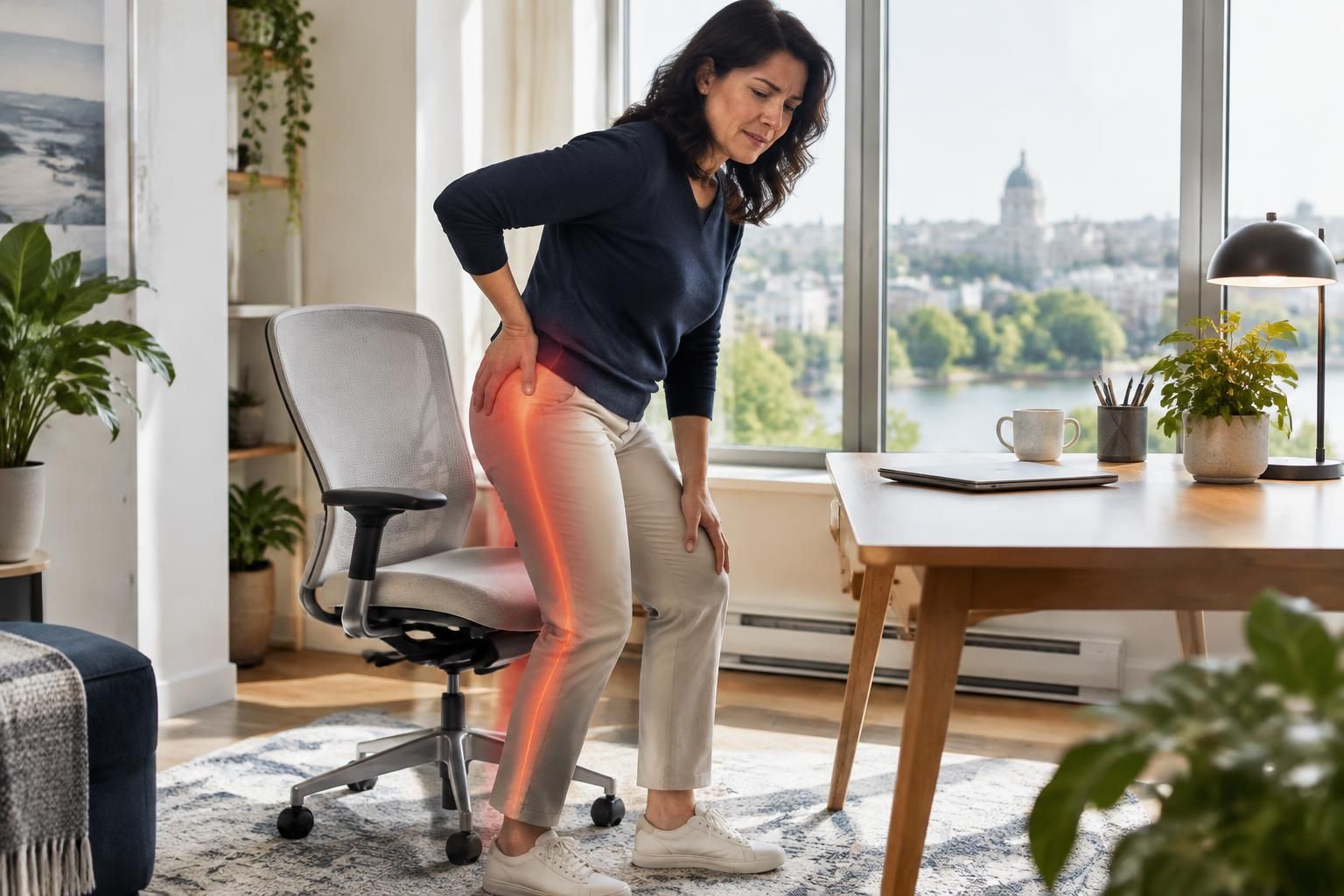
Sciatic pain that appears or worsens while working remotely in Verdun does not necessarily mean that your workstation is the sole cause. Staying in the same position for a long time can make symptoms more pronounced, but pain that travels into the buttock or leg may also be related to irritation of a nerve root or to other back or hip issues. A few workstation adjustments and active breaks may help you better tolerate the day, without replacing an assessment if symptoms persist or worsen.
The goal is not to find a perfect posture or force stretches, but to vary positions and observe what changes the pain. In Verdun, as elsewhere in the Montréal area, days at home may alternate between online meetings, screen work, and limited movement: small achievable changes matter more than an expensive setup applied rigidly.


In brief: first steps for sciatic pain while working remotely
Vary your position. Alternate sitting, standing, and walking according to your tolerance; remaining still for a long time can increase discomfort for some people.
Set up your workstation without aiming for perfection. Well-supported feet, a screen at a comfortable height, and an external keyboard can reduce unnecessary strain.
Monitor how symptoms change. Pain that travels below the knee, persistent numbness, or weakness warrants a clinical assessment.
Do not force movements. A stretch or exercise that increases leg pain or causes tingling to spread should be stopped.
Sciatic pain and remote work in Verdun: understanding what is happening
The term “sciatica” often refers to pain that follows part of the nerve’s pathway, from the lower back or buttock toward the thigh and sometimes the calf or foot. Irritation of a lumbar nerve root, particularly related to a disc or narrowing around the nerve, can cause this type of symptom. However, the pain pattern alone cannot identify the cause or the nerve root involved.
Pain felt in the buttock or leg may also be referred from the back or originate from other structures. Discomfort that worsens while sitting does not automatically establish piriformis syndrome: this condition can resemble radicular pain, and the distinction relies on the symptom history and examination. Pain, tingling, reduced sensation, and weakness are not equivalent; each provides different information during an assessment.
Seated work can change symptoms because it keeps the body in a given position and reduces opportunities to move. However, there is no universal threshold at which a chair would necessarily “compress” a disc or trigger sciatica. Some people feel better walking or standing, while others tolerate prolonged standing poorly. Your response, rather than a fixed rule about the number of minutes, is the useful guide.
For example, someone answering emails on a laptop placed on the kitchen table may lean toward the screen, bring their head forward, and keep their legs still. Changing the screen height or taking a short walk may make the task more comfortable, but does not demonstrate that posture was the sole cause of the pain. To explore possible causes and the assessment process further, see the guidance on the causes and diagnosis of sciatica.
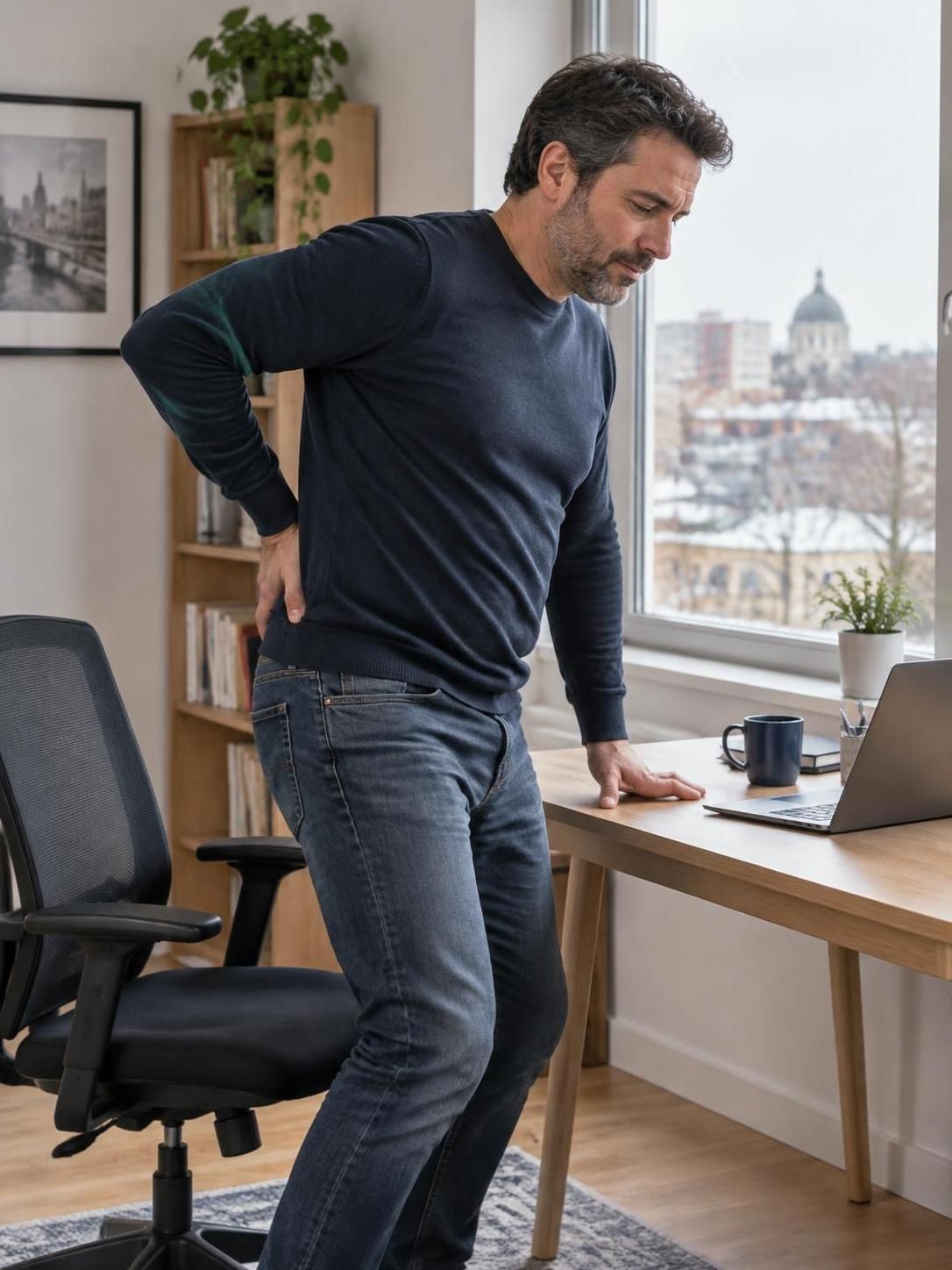
Workstation setup: ergonomic posture that remains adaptable
An ergonomic posture is not a position to maintain all day. Instead, it aims to make work comfortable and avoid unnecessary strain while allowing you to move. An adjustable chair is useful, but an ordinary chair may be suitable if your feet are supported, the seat does not force a painful position, and your back can change positions.
Start with the easiest elements to change: bring frequently used items closer, place the screen at a height that avoids constantly bending your head, and adjust the keyboard so your shoulders stay relaxed. With a laptop, a stand to raise the screen, combined with an external keyboard and mouse, can make the setup more comfortable. If your feet do not reach the floor, a stable footrest or sturdy box may help support them.
A cushion or rolled towel in the curve of the lower back may be tried if it improves comfort, but it is not essential and does not suit everyone. The same caution applies to chair height and knee angle: a position close to 90 degrees may be comfortable, but it is not a universal prescription. If the support increases pain or forces you to arch your back, remove or adjust it.
Standing should not become another form of immobility. A height-adjustable desk is practical, but you can stand up for a call or take a few steps between tasks. A small support for alternating foot positions may be comfortable for some people; it does not need to maintain a particular posture. The main thing is to be able to change positions without causing lasting worsening.
| Work situation | Adjustment to try | What to monitor |
|---|---|---|
| Laptop placed low on a table | Raise the screen and add an external keyboard and mouse | Do your neck and shoulders stay more relaxed? |
| Feet unsupported | Adjust the chair or use a stable footrest | Is your leg position more comfortable? |
| Long online meeting | Plan to stand up or walk briefly, if possible | Does the pain ease, remain stable, or worsen? |
| Prolonged standing | Alternate with sitting and short periods of walking | Does discomfort in the back or leg increase? |
An effective workstation setup is one that supports your activity and can be adjusted based on symptoms, not one that promises to correct sciatica on its own.
Active breaks and gentle stretching: moving without worsening symptoms
Short, regular active breaks can interrupt long periods of immobility. They may involve walking around the home, getting a glass of water, doing a few comfortable movements, or standing during part of a call. There is no ideal interval that applies to everyone; an alarm may help remind you to move, but it should not turn the day into a rigid schedule.
If walking is tolerated, start with a few minutes at an easy pace and observe your response during and afterward. If pain increases noticeably, travels farther down the leg, or is accompanied by new numbness, stop the activity that appears to trigger this change. A gradual return may be preferable to completely stopping ordinary activities, provided no emergency warning signs are present and movement remains tolerable.
Gentle stretches are not a universal solution. Stretching the buttock or back of the thigh can be uncomfortable when a nerve root is irritated; pulling hard on the leg or trying to reproduce an intense sensation is not necessary. If a movement causes pain to travel farther down, more pronounced tingling, or weakness, stop it and seek advice rather than “pushing through.”
Exercise advice for sitting may provide ideas, but it does not replace a selection tailored to your symptoms; you can consult a resource on exercises associated with sciatica to understand this variety. Another article on movements to prioritize and when to seek care may help clarify the limits of self-management.
In everyday life in Verdun, walking trips, household tasks, and time in front of a screen can be spread throughout the day. You do not need to add an intense workout to move more: a few tolerated transitions between tasks can already break up immobility. The goal is activity compatible with your condition, not performance.
When to seek care and management options to consider
A clinical assessment is appropriate if pain persists, recurs frequently, travels below the knee, disrupts sleep, or limits walking and everyday tasks. Persistent tingling, an area with reduced sensation, or weakness should also be reported. Someone who drops objects, trips more often, or notices that one foot responds less well should not limit their actions to adjusting their chair.
Seek urgent medical assessment if you lose bladder or bowel control, have numbness in the saddle area, significant or rapidly progressing weakness, major trauma, fever, or poor general health. Rapid worsening, or pain associated with a context of cancer or infection, also requires prompt assessment. These signs cannot establish a diagnosis remotely, but should not be managed solely through workstation adjustments.
When emergency warning signs are absent, management depends on the symptoms, their duration, and the examination. A professional may recommend maintaining or gradually resuming activities, tailored exercises, and manual care when appropriate. Physiotherapy in Verdun may be an option to discuss with a health professional according to your situation and the services available; the choice of practitioner should take assessment and rehabilitation needs into account.
Medication may be considered based on the advice of an authorized professional and each person’s individual risks. In some cases, an injection or specialist opinion may be discussed. Surgery is reserved for selected situations, for example when the clinical course or a neurological deficit warrants it; it is not the automatic response to radiating pain.
Motorized neurovertebral decompression is a form of controlled traction that may be considered for certain patients after assessment, particularly when the presentation suggests disc or foraminal involvement. It aims to temporarily alter certain mechanical stresses, but results vary and the evidence does not support it as a general solution. It does not put a disc “back in place,” replace urgent medical consultation, or guarantee avoidance of surgery; contraindications and appropriateness must be verified on a case-by-case basis.
In Montréal, Clinique TAGMED is located at 1140 Beaumont Avenue in Mount Royal, near Outremont and Côte-des-Neiges; it can assess the appropriateness of approaches such as motorized decompression or specific osteopathy, depending on the clinical profile. This does not mean that a treatment is suitable for every type of sciatic pain. Information on sciatica assessment and management options may help prepare questions to ask.
For preventing low back pain, the realistic goal is to maintain varied activities and an adaptable workstation, rather than avoiding all movement or adopting a rigid posture. A medical consultation or clinical assessment becomes particularly useful when symptoms do not improve, limit everyday life, or change in nature.
Frequently asked questions about sciatic pain while working remotely
Should you stop working while sitting as soon as the pain begins?
Not necessarily. Try changing position and taking a short break if tolerated, then observe how symptoms change. If sitting becomes impossible or symptoms progress, seek an assessment.
Can lumbar support relieve sciatica?
It may improve comfort for some people, but it does not treat all causes of pain radiating into the leg. Remove it if it increases discomfort or forces you into an uncomfortable position.
Which stretches should you do during a flare-up?
No stretch is suitable for every presentation. Choose only gentle, tolerated movements; stop if pain travels farther down, tingling increases, or weakness appears.
When should you seek care for pain that travels down the leg?
Persistent or recurring pain, pain below the knee, or pain accompanied by numbness, weakness, sleep disturbances, or limited walking warrants an assessment. Bladder or bowel problems, saddle anaesthesia, and rapidly progressive weakness require urgent medical help.
Is neurovertebral decompression indicated for all sciatica?
No. It may be considered for certain presentations after assessment, but is not suitable for everyone and results vary. It does not replace either urgent assessment or other management options when they are needed.
If pain travelling down your leg makes your remote workdays difficult, an assessment can clarify likely causes, signs to monitor, and whether a conservative approach is appropriate. For information on assessment options in Montréal, see the Clinique TAGMED contact page.
Sylvain Desforges, B.Sc., D.O., N.D., Doctor of Osteopathy
This content is provided for educational purposes and does not replace a personalized assessment or medical advice.
